











Article from Spring 2014 Issue #26
Grab the Digital Version
Dolly Parton’s Imagination Library
If you know Dolly Parton’s story, you know it’s something straight out of a fairy tale. Born dirt-poor in a two-room wooden shack in the mountains of Tennessee, one of twelve children, she headed to Nashville the day after high school graduation to become one of the biggest country stars in history. Most of us know her movies, her songs, her love of glitz and big hair, her sweetness and warm, self- deprecating humor (“you’d be surprised how much it costs to make a person look this cheap!”). But did you know that to children all over world, she’s known as the Book Lady?
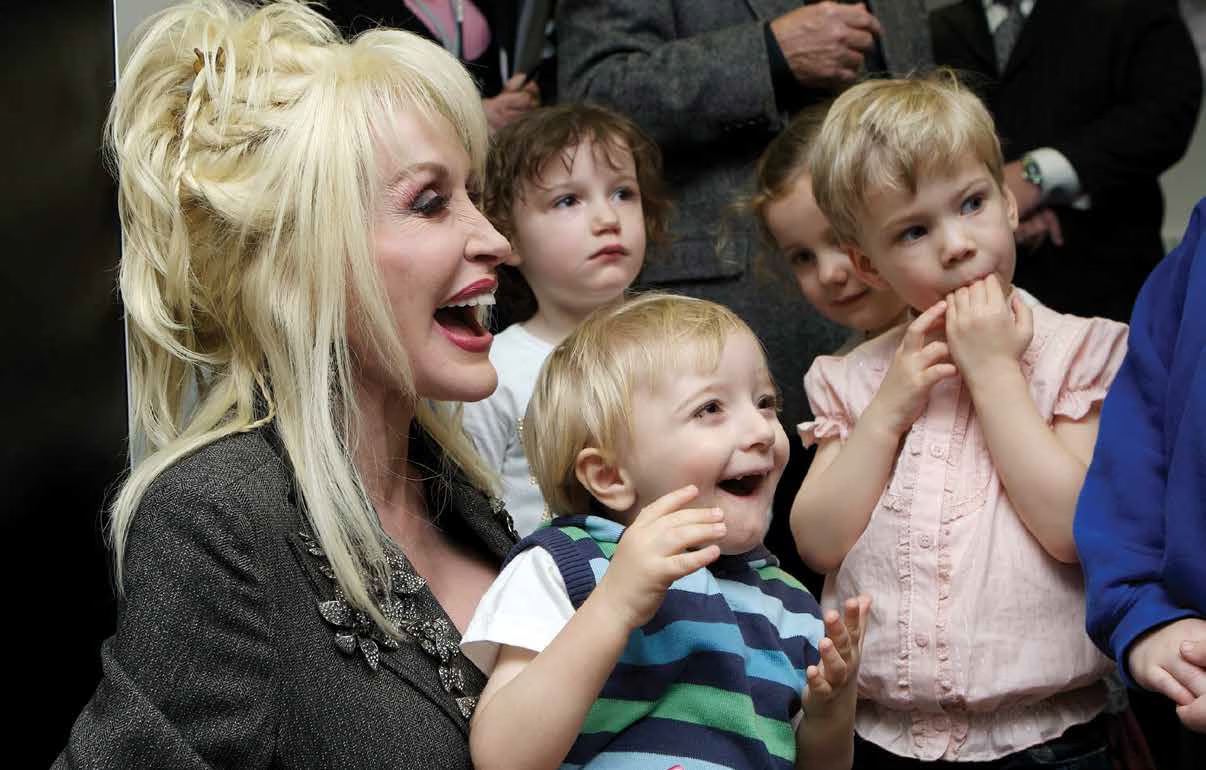
Dolly Parton is passionate about books. Because of her, and her Imagination Library, over seven hundred thousand children between the ages of zero and five receive a brand-new book in the mail each month in an effort to promote literacy. And more than that: to promote possibility, the ability to imagine, the ability to dream.
Dreams are important to Dolly Parton, and she credits them for her rags-to- riches real-life fairy tale. “Dreams took me from a shack at the foothills of the Great Smoky Mountains,” she writes in her 2012 book Dream More: Celebrate the Dreamer in You, “to Nashville and then to Hollywood. And then around the world, like Cinderella and the Fairy Godmother all combined, in glitter, high heels and hair.” Dollywood Foundation president David Dotson says, “When you look at her story, there’s really no logic as to how someone can come from her situation and be who she is today. As she herself often says, ‘I can’t give anyone advice, but I can share my story.’ And her story is built upon her dreams.”
Before the Imagination Library was Dollywood. In a 1982 interview, Barbara Walters asked Dolly what else she could possibly do now that she’d conquered both Nashville and Hollywood. Her answer? She wanted to build a theme park in her hometown and call it Dollywood, a “sort of a fantasy city … a Smoky Mountain fairy land.”
When the manager of Pigeon-Forge-based theme park Silver Dollar City saw the interview, he arranged a meeting with the star and suggested she transform the existing park into her vision. Parton became co-owner and the park was rechristened Dollywood in 1986—despite every adviser in her life telling her it was the dumbest idea she ever had. As Dotson says now, quoting Parton, “And here we are more than twenty-five years later and Dollywood is here and all those lawyers and advisers aren’t!” He continues: “She really did, as she always does, rely on her intuitive sense of what to do and when to do it, and as almost always happens her intuitive sense was correct.”
Not only was Dollywood a “fairy land,” but it supplied a number of jobs to local workers and celebrated Smoky Mountain culture by showcasing the region’s history as well as traditional arts and crafts and music. In the year after Dolly came on board, when the only real change was the park’s name (much expansion would follow), park attendance increased by several hundred thousand visitors. Since 1986, the park has doubled in size and become Tennessee’s largest paid tourist attraction. Today, with more than three thousand people on its payroll, Dollywood is the largest employer in Pigeon Forge.
But Parton always felt that she had an even bigger responsibility, having been so blessed with fame and fortune, to give back to children. The Dollywood Foundation was created two years after Dollywood was established, in 1988, as an organizational framework for her good works. These were, at the beginning, performed on an ad hoc basis—donating computers, giving scholarships. When it became clear that Sevier County had a serious high school drop-out rate, for example—with only a third of students graduating—Parton visited the fifth- and sixth-graders of Sieverville to initiate a peer accountability program in which students paired up and supported each other through their high school years. The kicker? Parton promised to come back and personally hand each graduating student a five-hundred- dollar bill. It worked, with the drop-out rate falling to six percent.
This success began to catalyze the community. Local industry banded together and pledged to not allow students to work before 3 p.m. (ready jobs in the tourism industry contributed greatly to the drop-out rate)—a move that’s kept the drop-out rate low. “That sort of got the wheels turning,” says Dotson. Parton and her team stepped back and asked: if we could do one thing to help kids achieve their dreams, what would that be? The answer seemed clear: help them with their education. And the best way to do that? Help them to read. Teach not only the skill of reading, but the joy and the love of it, the emotional attachment to reading that Parton herself has. And instill this love as soon as possible, before a child even enters school.
From this initial idea, Imagination Library was born. The team deliberately designed the program to make the experience of reading as joyful as possible. Parton didn’t want it to feel like a social program or a charity, so the team decided that each book would be mailed directly to each child—a special gift just for him or her. And there had to be an abundance to the program, too: “Dolly Parton would never give somebody just one book a year!” says Dotson. “She’s going to give a book a month! It had to be enough of a book statement to make a difference.” The team hand selected the books themselves, separating the choices by birth year. Over the course of the program, each child would receive sixty books in all.
The program launched in 1996 to all eligible, pre-Kindergarten children in Sevier County, Tennessee. It was such a hit that before too long, inquiries came in from other parts of the county, and an article in Southern Living stirred additional interest. By 2001, the Dollywood Foundation had a plan and an approach for communities wanting to adopt what they were doing. The basic model is that each community pays for the cost of its children, while the Dollywood Foundation manages all the administrative and managerial duties of the program. “At the time we were mailing books to twenty-five hundred kids a month in Sevier County,” Dotson says, “and we thought wouldn’t it be great if a few other counties did this. But what happened far exceeded all of our expectations.” Between 2001 and today, the Imagination Library has grown from two thousand kids to over seven hundred thousand kids a month, and has sent more than fifty-five million to children in four countries and fourteen hundred different communities.
“It really took on a life of its own,” Dotson says. “And much to [Parton’s] joy and surprise she started becoming known as the Book Lady.” Today Parton is a voracious reader, churning through several books a week. But books were scarce in the little shack where she was raised. There was the Bible, and the yearly arrival of the Sears Catalog. Most of the adults in the community—including Parton’s father, whom she calls the “smartest man in the world”—could neither read nor write. But Parton’s mother would take the girl on her lap and read her stories from the Old Testament, wild and vivid tales that sparked Parton’s imagination and let her imagine a world beyond the world she knew.
Before her father died in 2000, he told her something surprising: that for all her accomplishments, he was most proud of the fact that kids around the country called her the Book Lady. “To [those kids] (and probably to you!),” she says in Dream More, “I look like some cartoon character who loves them so much I figured out a way to help them have a roomful of books.”
In Dream More, Parton writes: “When I thought about my Mama reading the Bible to us, it hit me that if kids had books in the home, just maybe someone would read to them and help them love books. Even more important, maybe it would inspire them and spark in them the kind of wild imagination that I have so they will thirst for what’s out there in the big world.”
To learn more about the Imagination Library, or to replicate it in your own community, visit imaginationlibrary.com.