

















I’m always just a little too late to the occasion. I learned of the eternally fabulous Nita and Zita in 2016 from a waiter at a restaurant in the Faubourg Marigny of New Orleans. This was two doors down from where they’d lived in a Creole cottage for the last three decades of their lives. They’d been dead for more than 30 years. He asked me if the tattoo on my chest, the face of a flapper, was inspired by them. It was not, but I was immediately intrigued, as I am by anything from the Jazz Age and every other era of the 20th century that I was born too late to have experienced. I consulted the dusty archives of a search engine (but in my heart, I was at an old library breathing in the aroma of books, possibly wearing a monocle). I found very little.
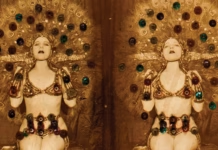
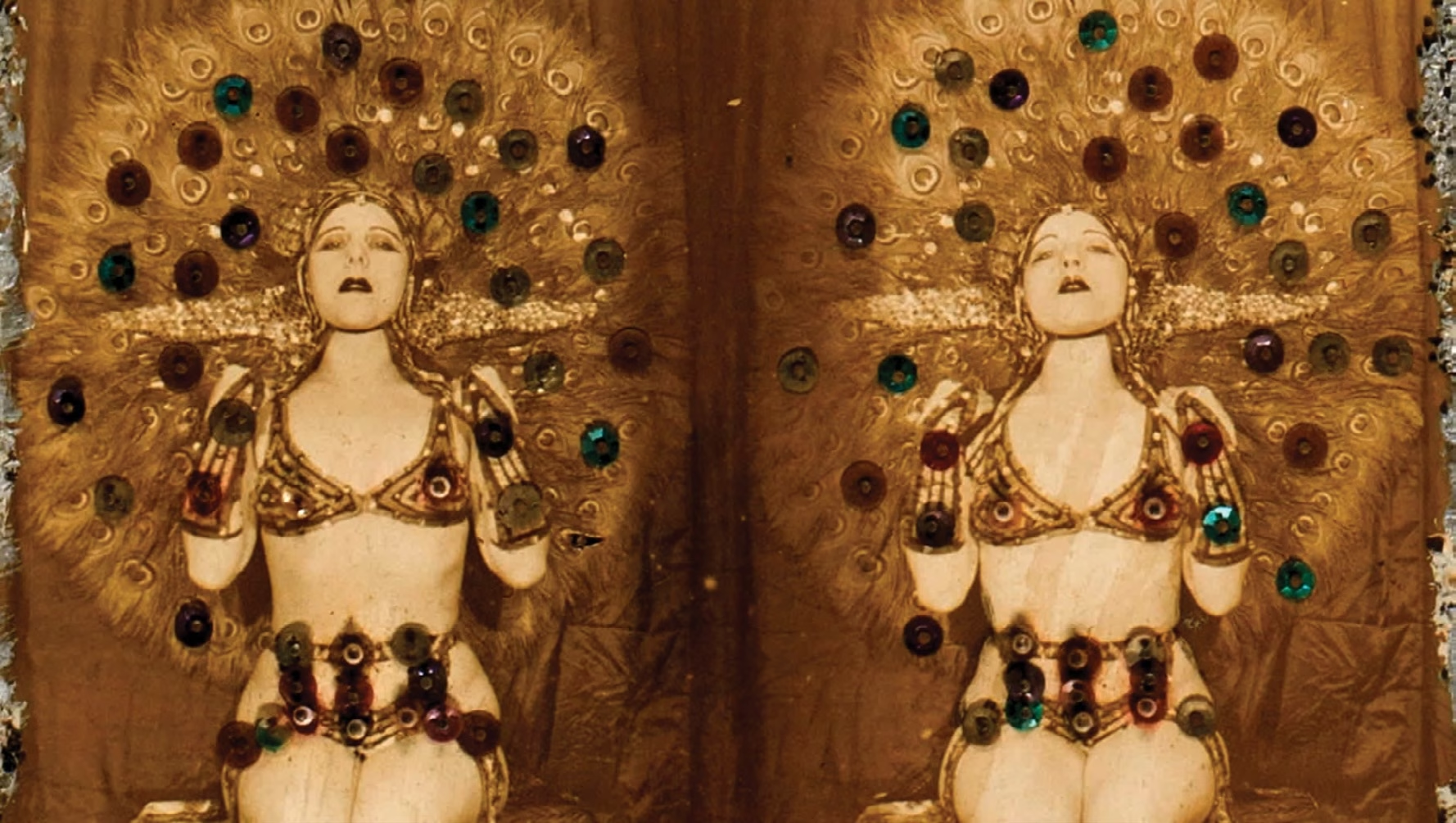
Undeterred, I eventually came across a stray article with grainy images showing the two women impossibly bendy and at the same time impeccably spangled. Nita and Zita, née Flora and Piroska Gellert, were Jewish Hungarians who’d fled the increasing antisemitic zeitgeist of their country in the 1920s and danced their way all over the rest of the world, bewitching audiences from Asia to South America, New York City to New Orleans, where they retired from the public eye in the late 1940s. They lived out their lives as mysterious recluses in that Creole cottage in the Marigny, which they turned into a work of folk art.

The end? A few months after learning about them from the waiter, I interviewed Stacy Hoover, owner of Bywater Wonderland, for the spring 2016 issue of Enchanted Living and the sisters came up again—specifically, in connection with the subject of a sensational five-year estate sale. After Nita and Zita had passed away in 1985 and 1991, their neighbor was given permission by their only remaining relative to sell the impressive contents of their home, their hand-stitched costumes and headpieces, hundreds of them, signs they’d painted, photographs and collages, handmade dolls, and heaven only knew what other treasures. Could I still find something, anything? I wondered excitedly. Naturally I was about 20 years too late. I wouldn’t give up hope. I’d continue to search every musty corner of New Orleans for signs of the sisters—a once vibrantly colored costume, now tattered, its colors faded to sherbet tones. A broken doll with matted hair and discolored skin.
A broken teapot with spiderwebs painted on it. A collage of photographs, embellished with pailettes, loosened by yellowed glue. I desperately wanted what they’d left behind, even if, unless intentionally preserved, most physical objects deteriorate. Surely their energy lived on in these things. I have a closet of hundred-year-old dresses that are barely hanging on, the seams gaping thanks to disintegrating threads, each of them with a story to tell.
Over the years, I’d learn more about Nita and Zita, from the Historic New Orleans Collection’s archives to other articles found online, including real estate sites advertising the sale of what was once their home. And I realized that, as much as I’m fascinated by the earlier, flashier part of their lives, I am equally curious about their reclusive years and the home that they’d adorned with sponge-painted polka dots, elaborate patterns, inside and out, on appliance, toilet, and bathtub—Nita and Zita’s Playhouse, where they likely were very poor, as evidenced by their use of tin-can lids to patch holes.
Trivial concerns, as wealth is temporary but glamour is infinite and legends are forever. From what I’ve gathered, Nita and Zita were known in the neighborhood, but no one really knew them. They’d rarely allow a trusted neighbor into the house, and for the most part they kept everyone at arm’s length. What is very common in New Orleans, a city that often masquerades as a small town, is word of mouth. People have always fabricated stories for fascinating people, and local lore becomes the legend, the darker and dirtier the better. Some may say the word gossip like it’s a bad word, but who doesn’t love a good salacious bit of speculation? Rumors that the so-called sisters were not sisters by blood, but lesbian lovers. Rumors that they ran a brothel. Scandal tropes the stark reality of antisemitism, war and survival, not to mention retirement from a profession that demands youth and never-fading beauty. History is portrayed in black and white, but there’s always the potential for a Wizard of Oz moment so that we may see a spectacular variety of colors. There’s amber for tragedy, rose for nostalgia. Red for immorality.
It seems Nita and Zita lived on their own terms from a very young age. They left their family and their country when most girls would have stayed. They bravely danced in Berlin in 1939 when at any moment they might have been taken by the Nazis. They were partners at a time when most women became wives and mothers. To the modern-day observer, they dazzled on stage but a hundred years ago, women in burlesque and vaudeville were not respected as they are today. I unabashedly romanticize women like this, women of the past who lived unconventional lives, always ahead of their time.
I’ve felt the ghosts of Nita and Zita often in this city, especially my neighborhood, where my own Creole cottage is only a couple blocks away from theirs. Life in the Marigny seems idyllic, with artful surroundings, beautiful old homes with wrought iron balconies and gingerbread wood scrolling that make visitors gasp, chandeliers and swings hanging from trees that line the streets, and a deceptively familiar feeling of being in a quaint place. But look closely and you’ll see what’s broken—the sidewalks destroyed by old tree roots, profoundly neglected homes, and boarded-up stores that once occupied buildings dating back hundreds of years. You see the people who are perpetually lost, sleeping or shooting drugs on porches. You realize it’s not an easy place at all. It’s a transient place; people dabble in living here but then leave for the safety of elsewhere. It’s no wonder that, after traveling everywhere in the world, Nita and Zita settled right here, a locale that collects the eternally restless misfits. New Orleans has adopted me too. I like to think of Nita and Zita as patron saints of the Marigny or, as their Jewish brethren might instead consider, tzadkanit, spiritual guides.
I was excited when, last year, Marci Darling’s The Nita & Zita Project was released. I watched rapt as some—thankfully not all—of the mystery behind the sisters was revealed. I love that there is still plenty left to the imagination. Above all, I was grateful to see more than a grainy photo or two, shadows of a derelict bathroom painted with polka dots. I walk by that house all the time and realize it would have deteriorated beyond repair had they not completely gutted it, painted, and restored the roof.
It is unrecognizable now, and I might have cried a little when I saw that it was on the market several years ago with a sparkling, soulless, ultra-modern interior. I would have bought that house before it went to that extreme, but yet again, I was too late.
I can’t help but feel Nita and Zita’s mystique was an intentional power move, and I like to think that even after death, they are getting just what they wanted. Newspaper articles about them reflect ever-changing ages, countries of origin, mentions of arrest, and finally their retirement, complete with an advertisement for their exercise classes. Show advertisements bill them as Romanian or Oriental or simply exotic. They were described as burlesque stars, international dancers, contortionists. The names changed often as well, Piroska and Flora, Flora and Zita. Through the tease, they were the puppet masters—the thrilling audacity of that!
Nita and Zita are buried in a marked grave under their birth names, Flora and Piroska, in the pauper’s section of Hebrew Rest Cemetery in New Orleans. Nowhere on that headstone is it noted that they were legends. I go and leave stones, hoping they know that many women like me are so appreciative of them. We consider them pioneers, women of the Greatest Generation, leaving us breadcrumbs of feathers and sequins. The rest we are left to make up on our own.