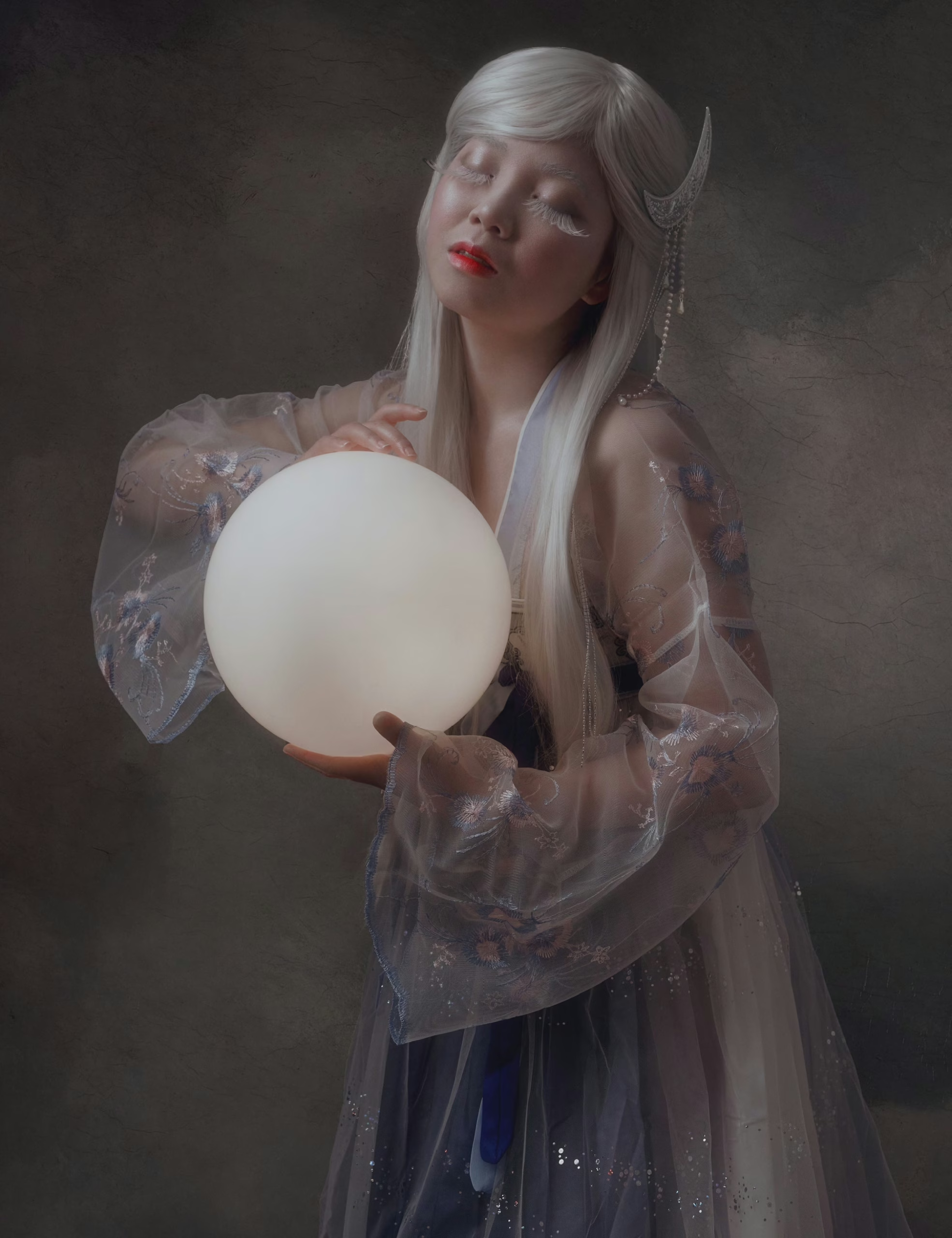








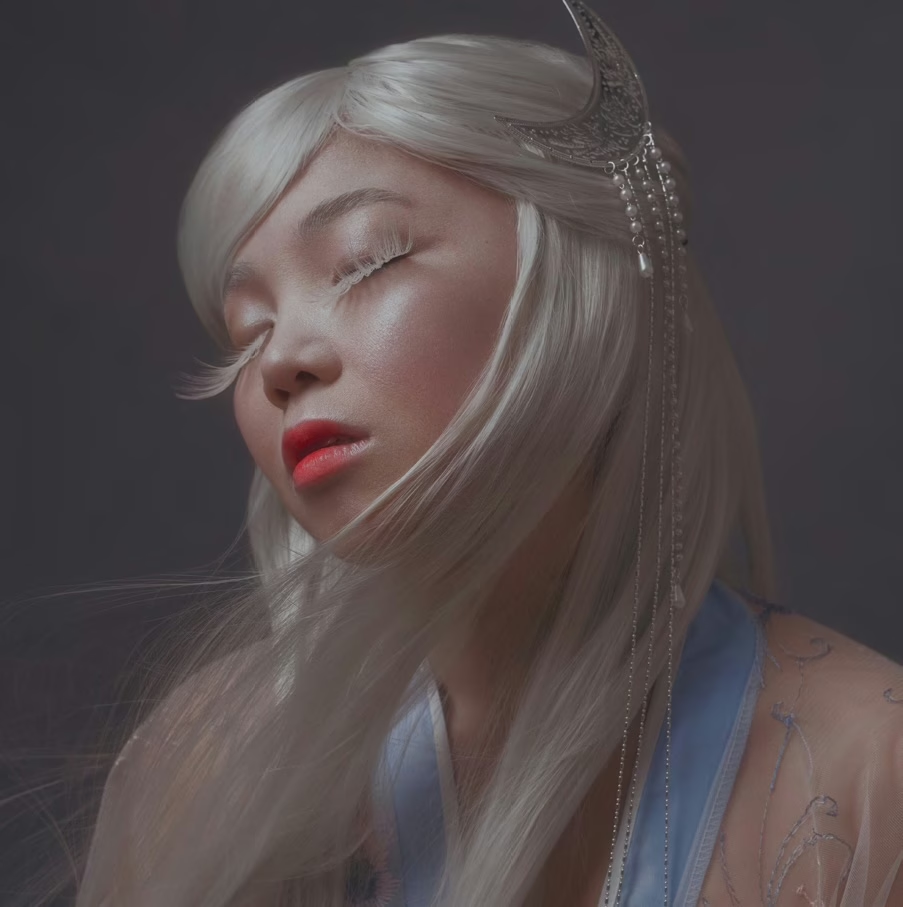
Photography by Hajnalka Ber.nyi-Kiss
Once upon a time, there was a princess who wanted the moon. Her name was Lenore, and you can read about her in James Thurber’s fairy tale “Many Moons.” One day, Princess Lenore fell sick, and she told her father that only one thing could cure her: the moon. Her father the king asked his high chamberlain to get her the moon, but the chamberlain said it was impossible: The moon was very far away, and as large as the princess’s bedroom. So the king asked his royal wizard, but the wizard also said it was impossible: The moon was even farther away, and as large as the palace. So he asked the royal mathematician, who said the moon was even farther away than that, and as large as the kingdom. The mathematician said it was impossible as well.
As you can imagine, the king was quite depressed—his daughter wanted the moon, and it seemed nothing else would make her well again. Finally, the court jester asked him what was wrong. The king explained the whole moon situation. The jester thought for a moment, and then said, “The chamberlain and wizard and mathematician are all wise men, so they must all be right. But has anyone asked Princess Lenore what she thinks?” I’m paraphrasing here—Thurber’s story is longer and more charming than my brief summary. But you can probably see that the jester was wiser than those three official wise men. He went to Princess Lenore and asked her how large she thought the moon was, and she said, “It’s about the size of my thumbnail, because when I hold up my thumb, it just covers the moon.” She thought it should be easy to catch, because it floated just above the top of the tree outside her window and sometimes got caught in the branches.
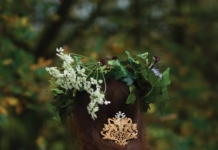
So the jester had the royal goldsmith make a golden disk about the size of the princess’s thumbnail and put it on a gold chain, and then presented it to Princess Lenore. She immediately felt better and was overjoyed to wear the moon around her neck. But the king still had one worry:
What would happen when the princess saw that the moon was still in the sky, night after night? The high chamberlain suggested she wear dark glasses every evening, the royal wizard recommended black velvet curtains to block out the moon, and the royal mathematician thought it would be best to set off fireworks in the palace gardens every night—surely then she would not notice the moon in the sky. But the court jester went to Princess Lenore and said, “Princess, how is it that the moon is still in the sky when you are wearing it around your neck on a gold chain?” The princess replied, “Silly, of course it grows back! Just like when I lose a tooth, or when the royal gardener cuts a flower in the palace gardens and a new flower grows in its place.” Which proves that the princess was also wiser than the official wise men, and that you can ask for the moon and get it—you just have to know what it is for you.
Why do you think Princess Lenore longed for the moon? Perhaps it’s because women have been associated with the moon in myth, legend, and fairy tale for centuries. In Greek mythology, Selene was the original embodiment of the moon, eventually replaced by Artemis as the goddess of the moon, the hunt, and wild animals. But Hecate, goddess of witchcraft and mystical knowledge, was also associated with the moon. Roman mythology had Luna and Diana, counterparts to Selene and Artemis. The Thracian goddess Bendis was associated with both the moon and the hunt, as was the Slavic Devana, who may have been a version of Diana. In Chinese mythology, Chang’e was not just the goddess of the moon but also the protagonist of a famous legend. She was originally a mortal woman but discovered the elixir of immortality given to her husband by the gods. She drank it herself, then ascended to the moon, where she lives in the moon palace with her companion, the moon rabbit Yutu. (If you look up at the full moon, you may be able to see his shape in the dark markings on its shining surface.)
Chang’e is still celebrated in the autumn Moon Festival, when moon cakes (pastries traditionally filled with lotus seed or red bean paste) are eaten in her honor.
Probably the most famous fairy tale about a woman in the moon is “The Tale of the Bamboo Cutter,” about Princess Kaguya, who is discovered as a baby inside a bamboo stalk. She is raised by an old bamboo cutter and his wife, and grows into such a beautiful young woman that a number of prominent men—even the emperor of Japan himself—ask for her hand in marriage. However, she rejects them all, insisting that she is not from Earth and cannot marry a mortal man. Finally, she announces that it is time for her to return to her true home, the moon. Her people come down from the moon to take her back with them, and she ascends to her destiny as a moon princess. In the early 1900s, the American writer (and wife of the mayor of Chicago) Edith Ogden Harrison wrote a literary fairy tale called The Moon Princess in which Ethelda, one of the daughters of the Moon Mother, asks to spend her honeymoon with the Sun Prince on Earth. Unfortunately, while traveling through the earthly realms, she is kidnapped and hidden in a cavern underground—until her Sun Prince rescues her. Despite her misadventures on Earth, she has come to love it so much that Ethelda and her Sun Prince decide to make it their home, returning to visit her mother the moon once a year. Emily Dickinson also compares the moon to a woman in verse:
The Moon was but a Chin of Gold A Night or two ago—
And now she turns Her perfect Face Upon the World below—
Her Forehead is of Amplest Blonde—Her Cheek—a Beryl hewn—
Her Eye unto the Summer Dew The likest I have known—
Her Lips of Amber never part—But what must be the smile
Upon Her Friend she could confer Were such Her Silver Will—
And what a privilege to be But the remotest Star—
For Certainty She take Her Way Beside Your Palace Door—
Her Bonnet is the Firmament—
The Universe—Her Shoe—
The Stars—the Trinkets at Her Belt—
Her Dimities—of Blue—
This sounds a bit like Harrison’s Moon Princess, who also wears blue and is crowned with stars. No wonder Princess Lenore wanted the moon. In ancient myth and legend, it symbolized power, freedom, and immortality. In more modern fairy tales, it is associated with beautiful, heavenly women who choose their own destinies. Psychoanalyzing fairy tales is as dangerous as paraphrasing them—there is always something lost in the paraphrase or analysis. But perhaps we can see the princess’s request for the moon as a desire for the grown-up self she will one day become: a powerful woman with a destiny, like Chang’e. Perhaps we can think of the three phases of a woman’s life in this way: girl, moon princess, moon goddess. You can start out as Princess Lenore and eventually become Queen Luna.
“Asking for the moon” usually means to ask for something impossible, but with the help of the court jester, the trickster figure of the fairy tale, Princess Lenore turns the impossible into a talisman that she can wear around her neck. So maybe we should redefine the phrase: Maybe asking for the moon should mean asking for what seems impossible but is actually possible, if you know what you’re asking for and are confident in your ideas.
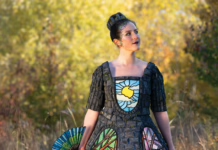
The moon is certainly a good symbol to wear on a chain around your neck. She is powerful, pulling the tides of the Earth’s oceans. She is constantly changing, renewing herself each month. She is our best friend and nearest neighbor, but remains mysterious. Poems are written to her and about her. She shines, but also has a dark side. That’s not a bad description of who we might want to be, once we grow up. I don’t know about you, but I wouldn’t mind getting to my Moon Goddess phase, living in the gardens of the moon with my pet rabbit or hanging out with Artemis in the forests of Arcadia. Learning to hex with Hecate. Eating moon cakes. Wearing the firmament as my bonnet, the universe as my shoe, and hanging the stars from my belt like a chatelaine.
The next time you want something and people say you’re asking for the moon, remember Princess Lenore and tell them, “Yes, I am. Absolutely.”
Photographer/Creative Direction/Post-production and retouching: Hajnalka Berényi-Kiss @heroinesandmuses
Model: Yinsey Wang @tornandpolished
Make-up: Jennifer Brillante @brijance.makeupartist
Hanfu and accessories: The Hanfu Story @hanfustory
Hair: Nina Willenpart @stylingsbynina, @shadesbynina
Retouching assistant: Julia Lomaka @julia_lomaka_retoucher