




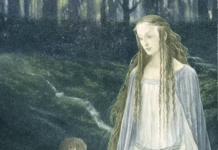
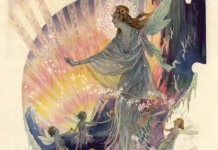






Galadriel of the shining hair, Lady of Lothlórien: She appears in only two chapters of The Lord of the Rings, but she is one of its central figures. Her realm, with its golden-leaved mallorn trees, its fields of elanor and niphredil (meadow flowers, the first with blossoms like small yellow suns, the second white like snowdrops), is the closest we can get to heaven on this earth—there is no sickness or evil in Lothlórien.
This is how J.R.R. Tolkien both described and painted it. Many artists have depicted the beauties of Middle-earth, but Tolkien himself was one of the best: His watercolors captured its magic and mystery. My favorite of his paintings shows a path through a sunlit wood. The forest floor seems to be littered with last year’s leaves, and this year’s leaves are still green on the trees. Among them nestle golden flowers—the mallorns, Tolkien tells us, have leaves that turn golden in autumn, then stay on the branches, falling to the earth only when the new green leaves appear in spring. Then, the golden flowers start to bloom. Green and gold and white—those are the colors of Lothlórien, and of Galadriel herself. Tolkien’s painting is titled, in his distinctive handwriting, The Forest of Lothlórien in Spring. You can almost imagine Galadriel walking toward you down the forest path.
Who was Galadriel, and where did she come from? Her tale is not told in The Lord of the Rings. You have to look in Tolkien’s more scholarly and comprehensive books, such as The Silmarillion and Unfinished Tales, in which he tried to create a history of Middle-earth. Even there, her story is a bit muddled, as though Tolkien never settled on a definitive version. We are told that she comes from a royal line related to all three of the elven clans:
the Noldor, Vanyar, and Teleri. She was one of” “those Noldor who rebelled against the Valar and were banished to Middle-earth. She later regretted her youthful rebellion and became a wise queen, the leader of her people. She married Celeborn and bore a daughter, Celebrían, who would go on to marry Elrond of Rivendell. Their daughter, Arwen, would become the bride of Aragorn, uniting elves and men.
In other words, she was a queen, a mother, a grandmother—and a warrior, who could fight as well as rule. She also had the ability to hear the thoughts of others, which allowed her to judge them fairly. No wonder she was entrusted with one of the three Rings of Power that were given to the elves—Nenya, the Ring of Adamant. With it, she protected Lothlórien and all who lived within it. It makes sense that, in the Peter Jackson films, she was played by Cate Blanchett, who has the right sort of unearthly beauty. Galadriel was the most beautiful of all the elves. Her most marvelous feature was her hair, in which silver and gold blended: It captured the light of the two trees of Valinor, the land across the sea that is Tolkien’s version of heaven. It was, literally, heavenly.
Scholars have argued about what inspired Tolkien to create such a majestic figure. Some have compared her to medieval angels, or to characters from the Arthurian cycle of tales. I think it’s equally likely that Tolkien was inspired by Norse goddesses such as Freyja, associated with love and war, who rules over the heavenly meadow of Fólkvangr; Sif, the wife of Thor, who is famous for her long, golden hair; or Idun, who guards the apples of immortality that grow on a tree in Asgard, as Galadriel guards Lothlórien. These Norse goddesses were also strong women who knew their own minds and made their own decisions—just like Galadriel.
“Galadriel was the most beautiful of all the elves. Her most marvelous feature was her hair, in which silver and gold blended: It captured the light of the two trees of Valinor, the land across the sea that is Tolkien’s version of heaven.”
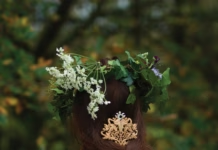
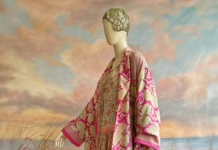
In Tolkien’s Middle-earth, elves are distinguished by three characteristics. The first is their love of beauty. It’s no accident that in the Peter Jackson films, the costumes and set designs for elven places like Rivendell and Lothlórien drew heavily on Art Nouveau, the most beautiful art movement of the late 19th century. You’ve certainly seen Art Nouveau, even if you’re not familiar with the term. It’s the sinuous, curving style inspired by vines and other natural forms that gave us Hector Guimard’s Paris metro stations, the posters of Alphonse Mucha, Louis Comfort Tiffany’s lamps, and jewelry by René Lalique. Artists Alan Lee and John Howe, who designed the look of Middleearth for the film trilogy, used that style deliberately to make all things elven look as though they were grown rather than made. In the film, Galadriel’s silver and gold headpiece looks like twining vines, and the broach she wears resembles a moon caught in the branches of a silver tree. Her flowing gown is white, but covered with what could be snowflakes or stars. Her silver-gold hair falls in long tendrils. All things elven are beautiful, and the elves themselves love beauty, whether in tools, clothing, or architecture.
The second characteristic is their love of the natural world. If there’s anything elves love, it’s their trees. The elves of Lothlórien are also known as the Galadrim, which means “Tree People” in Sindarin, one of Tolkien’s elven languages. They live not on the ground, but on platforms high in the mallorn trees, among the green-gold foliage. Tolkien himself was a passionate lover of the natural world, especially of trees, and he hated the way industrialization was changing the landscape of England. His best characters—the most morally good—are all nature lovers and protectors: Tom Bombadil and his wife Goldberry, the Ents, and of course the elves themselves. The Galadrim are protectors of their environment, as Tolkien would no doubt want us to be. In a short story called “Leaf by Niggle,” Tolkien wrote about an inconsequential man who becomes obsessed with painting an infinitely complex, perfect tree. He never finishes painting that tree—there is always another branch, another leaf—but toward the end of his life, when it is time to begin the “great journey,” he realizes that the journey is into the painting he created. Niggle’s attempt to create something larger than himself and beyond his abilities sounds rather like Tolkien attempting to create Middle-earth; we could see the branching narratives of The Silmarillion, for example, as another kind of tree. No wonder Middle-earth is a world of great forests, such as Mirkwood, Fangorn, and Lothlórien. Tolkien would say there is wisdom in trees—you just have to listen.
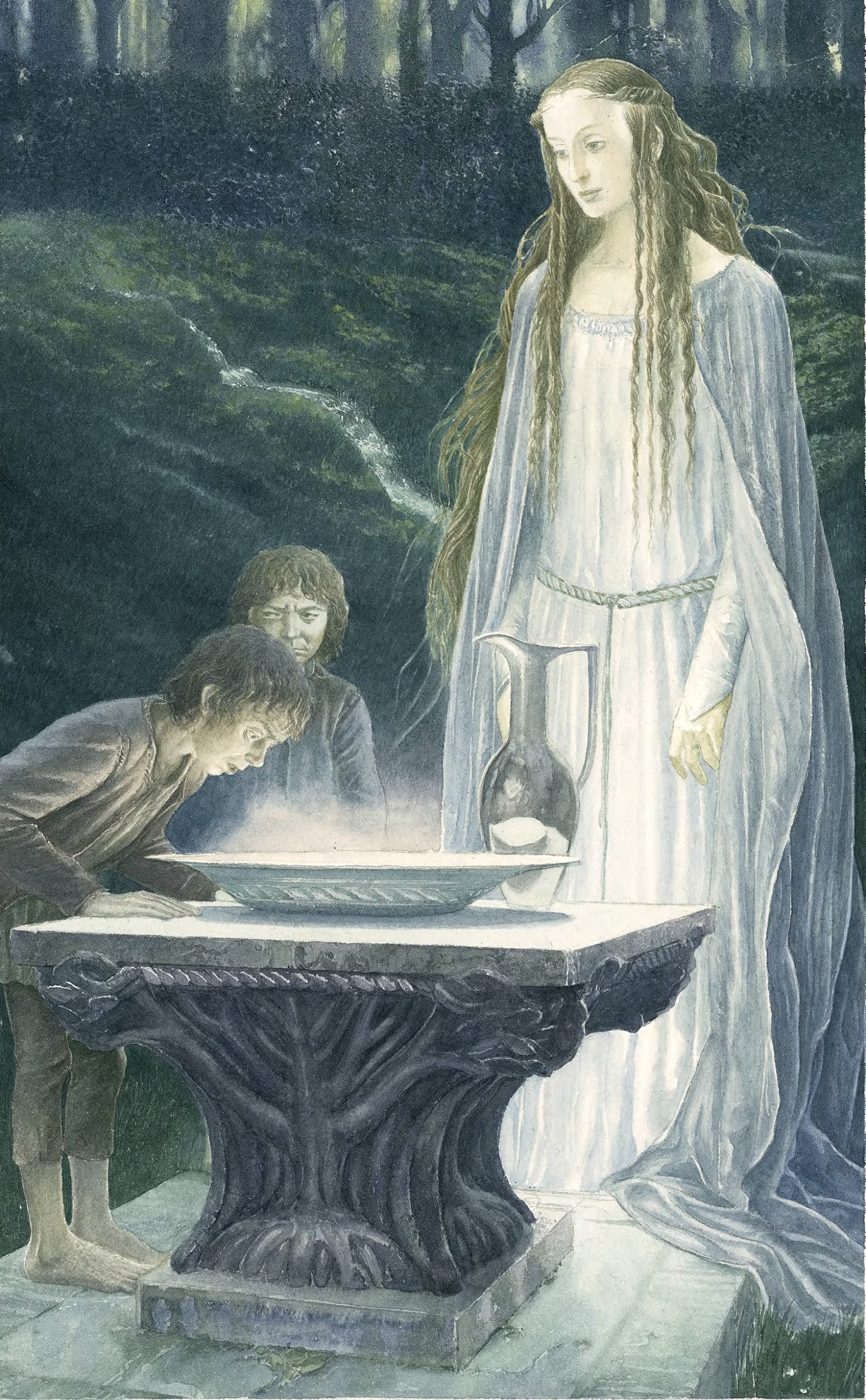
The third and perhaps most important characteristic of his elves is their battle for light in a darkening world—a battle that, for Galadriel, is internal as well as external. One evening during their sojourn in Lothlórien, Frodo Baggins and Samwise Gamgee walk among the trees together. Frodo wishes he could see the elven queen again before their company departs. Suddenly, there she is, a vision in white, walking toward them. She shows Frodo and Sam the Mirror of Galadriel—a starlit pool in which they see visions of what is and what might be. Among other dark tidings, Frodo sees the Eye of Sauron, searching for him. He is afraid that the Eye will find him, but Galadriel tells him not to fear, for Lothlórien is protected by her own ring, Nenya. After she reveals that she bears one of the Rings of Power, he offers her the One Ring that he himself carries. He thinks the burden of it is too great for him. How much better it would be if the Lady Galadriel could wield its magic.
Galadriel laughs, acknowledging that she has dreamed of claiming the One Ring for her own. It would allow her to accomplish so many things! She has indeed wanted such power. But then she rejects it, telling Frodo, “In the place of the Dark Lord you will set up a Queen. And I shall not be dark, but beautiful and terrible as the Morning and the Night! Fair as the Sea and the Sun and the Snow upon the Mountain! Dreadful as the Storm and the Lightning! Stronger than the foundations of the earth! All shall love me and despair!” Galadriel knows that such power would make her as terrible as she would be beautiful, as feared as she is loved. In a blaze of light, Frodo sees what she could become—glorious and terrifying. In the film version, this is a particularly powerful scene—the ethereal Cate Blanchett is suddenly as scary as Sauron. We understand, in a deep way, what Galadriel could become if she gave in to the temptation of the One Ring.
C.S. Lewis’s The Magician’s Nephew was published one year after the first volume of The Lord of the Rings. In it, we find a female character who is as beautiful as Galadriel, but who pursues and seizes ultimate power—the Deplorable Word. In doing so, she destroys her entire world. Her name is Jadis of Charn, but you might know her as the White Witch of Narnia. Lewis and Tolkien were good friends in Oxford, where they both lived and worked. They walked and talked together, sharing ideas and reading each other’s stories. I wonder if, in creating his White Witch, Lewis was thinking about this moment in Lothlórien and what would have happened if Galadriel had chosen a darker path. Instead, the elven queen chooses to remain herself. She laughs again, the light fades, and Frodo sees only “a slender elf-woman, clad in simple white, whose gentle voice was soft and sad.” She tells him that she has passed the test. Instead of almost infinite power, she will choose the higher moral road. We have already seen her take a higher road when the Fellowship entered Lothlórien. Although her husband Celeborn does not want to admit Gimli, son of Glóin, because of the ancient enmity between elves and dwarves, she insists that he should be welcomed like the other members of the Fellowship. She chooses inclusion and kindness.
When the Fellowship leaves Lothlórien, Frodo and his companions are given swift boats to travel on the river, warm cloaks in elven gray, and lembas bread, which the elves say will sustain them for a long time. Galadriel also gives him a crystal phial containing the light of Eärendil’s star to serve as “a light in dark places, when all other lights go out.” In Tolkien’s legendarium, Eärendil’s star is Venus, the morning star—the last light to disappear before sunrise. Later on his journey, Frodo uses it to ward off the fearsome spider Shelob in Cirith Ungol, the pass into Mordor. It is both a useful lantern and a symbol of hope. That is what Galadriel represents in The Lord of the Rings: light in the darkness, hope among the troubles of Middle-earth. The Fellowship’s sojourn in Lothlórien is the last golden moment on a dark, dangerous quest. When Frodo and his companions journey onward, bolstered by the gifts of the elves, Gimli carries with him a bit of Galadriel herself—three strands of her shimmering hair. Symbolically, the Fellowship carries with it all that the Lady of Lothlórien represents.
In The Lord of the Rings, Tolkien seems to be saying that we should also carry the light and hope of Eärendil’s star within ourselves. He wants us to value beauty, love the natural world, and choose the path of generosity and kindness. He shows us Galadriel to remind us what we are fighting for: all the beauty and goodness that is possible on our own Middleearth. Perhaps that is why, in the midst of a narrative filled with danger and darkness, he allows us as readers to pause on the journey and walk for a little while in fields of elanor and niphredil, under the mallorn trees of Lothlórien.
“If there’s anything elves love, it’s their trees. The elves of Lothlórien are also known as the Galadrim, which means “Tree People” in Sindarin, one of Tolkien’s elven languages. They live not on the ground, but on platforms high in the mallorn trees, among the green-gold foliage.”