












I think that it is a truth universally acknowledged that you might well have a challenging relationship with your mother-in-law. My own dear-departed Ma-in-Law was a feisty soul, and I loved her very much, but we sometimes had disagreements. I will admit that through my relationship with her, I was forced to grow a backbone, and she and I had to learn some boundaries, which can only be a good thing. In such times, I like to remember the story of Psyche and her mother- in-law Venus, whose magnificently dysfunctional relationship caught the imagination of artists throughout the 19th century.
The story of Psyche has an obvious attraction for painters; she was the most beautiful woman on earth. According to the 2nd century Roman novel The Golden Ass, Psyche’s beauty became such a draw that crowds of people would come to the palace to see this stunner, leading some to assume she was the goddess Venus made flesh. For painters, adding the title Psyche to a painting of a young, nubile woman gave it some mythological kudos; see William-Adolphe Bouguereau’s 1892 portrait of an earnest girl clutching her bosom and looking winsome. In the myth of Psyche, the knock-on effect of all that beauty was that Venus worshippers abandoned the temples and went straight to Psyche. As you can imagine, Venus was not very happy about that, and if we’ve learned one lesson from mythology, it’s to never annoy a god; they will get even, and they’ll be imaginative in the way they do it.
Venus’s revenge on the pretty girl was inventive. Venus told her son, Cupid, to flutter close to Psyche and shoot her with an arrow, thereby causing her to fall in love with the most awful creature available, preferably either a sea monster or even worse, someone poor. The goddess’s plan did not go as planned—what a surprise. Maybe there was a particularly harsh crosswind that day, but as soon as Cupid saw Psyche, he fell in love with her and whisked her away to safety. Obviously, for painters that was a marvelous moment to capture; Annie Swynnerton, for example, showed the winged god curling his feathers protectively around his love in her 1891 painting Cupid and Psyche. Psyche’s eyes are closed as she was not allowed to look upon her rescuer, and that’s when the trouble really started …
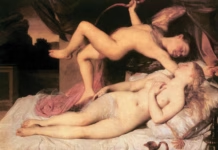
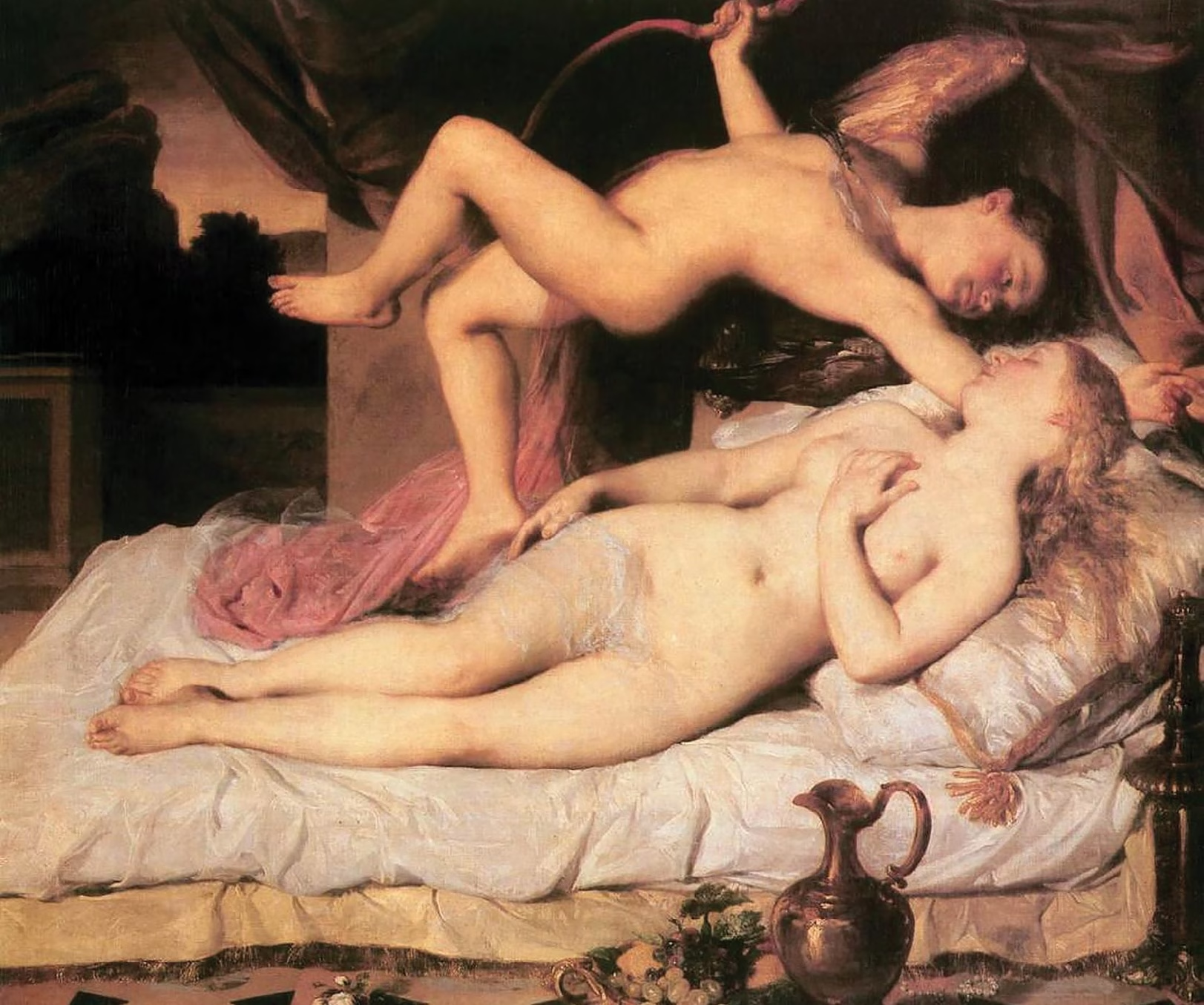
Venus was firmly of the opinion that no one could marry her son without earning it by performing impossible tasks. To start with, Psyche was not allowed to look upon her heavenly husband’s face. Hungarian artist Károly Brocky painted the odd couple in bed in his 1855 Cupid and Psyche, with Psyche sound asleep and Cupid fluttering above her, painfully twisting round in the air to look at her beautiful slumbering face. Of course, this arrangement was never going to last, as Psyche desperately wanted to know who her husband was and so sneaked a peek at Cupid by lamplight, unfortunately dripping some of the hot oil onto Cupid and causing him to flee in pain. In the Psyche Cycle murals at Castle Howard in Yorkshire, painted in the 1870s and ’80s by Edward Burne-Jones, the poor girl is seen bending close to her fabulously muscled husband in one panel, then on her knees in despair as his wings disappear through the doorway in the next. For Venus, this was the excuse she needed to really thwart her erstwhile daughter-in-law, and that’s when the impossible tasks really got going.
For starters, Psyche was given a huge pile of grain to sort, which would have been impossible, but she was assisted by an army of ants, in a lesser-known Roman-Disney crossover. Next, Psyche collected golden wool from enraged magical rams, but still Venus wasn’t satisfied. She commanded Psyche to collect water from the river Styx that flowed through the underworld, certain that the girl could not dip the crystal cup in the water safely. Once more, the animal kingdom came to Psyche’s assistance when one of Jupiter’s eagles swooped over the river and collected the water. Interestingly, despite the very dramatic nature of these tasks, artists did not choose to paint them. In Psyche at the Throne of Venus (1883) by Edward Matthew Hale, Psyche is sitting on the rose-strewn floor of Venus’s throne room, while the goddess looks down on her with gleeful malice, and within that image there is a fair amount of nudity. Possibly among Psyche’s first tasks, the likelihood of performing them in the nude was less and therefore of lower interest to artists, even with the promise of ants and enraged rams. Luckily, the final task that Venus demanded of Psyche allowed artists to revisit a myth that is always popular.
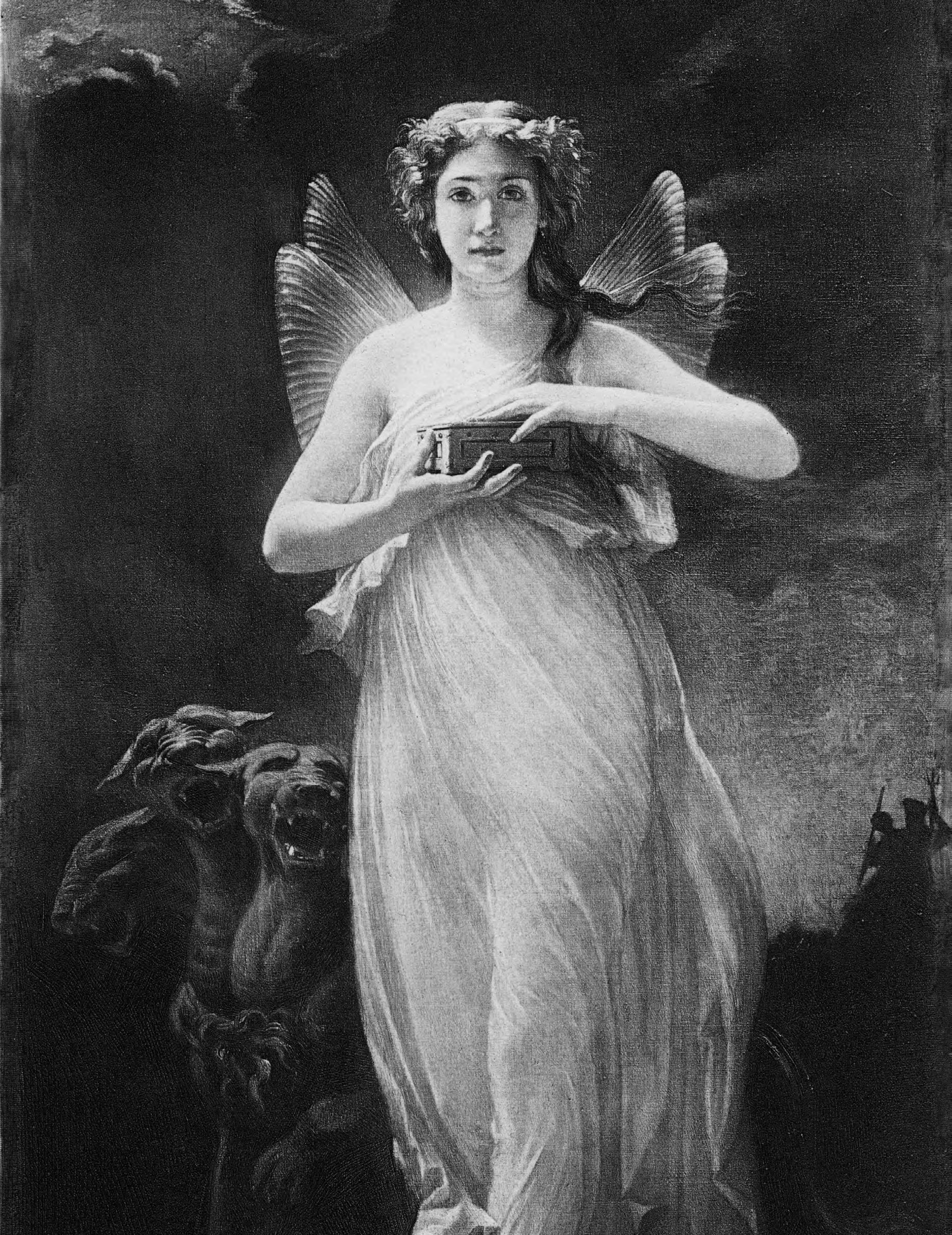
Venus tasked her unlucky daughter-in-law to travel to the underworld to collect some of Persephone’s beauty in a box and deliver it home. Psyche was warned that above all else, she should not look in the box. The images of the beautiful young woman carrying the box that she is absolutely and definitely not allowed to sneak even the slightest peek into of course look just like Pandora and her box of mischief. Alfred de Curzon painted Psyche proudly carrying the golden box in his Psyche in the Underworld (1859), before, inevitably, her curiosity got the better of her. John William Waterhouse went one fatal step further in Psyche Opening the Golden Box (1904). There, Psyche is raising the lid, just a little, but it will be her downfall. Venus tricked her, and as with Pandora’s box, there was nothing nice pouring out. Psyche was engulfed by a dark cloud and fell into a seemingly endless sleep.
Cupid was not pleased with the way his mother was behaving and decided to ask the family to stage an intervention. Jupiter, as his pseudo father figure, stepped in to make Psyche immortal and stop all Venus’s nonsense. After drinking ambrosia, the extra-special beverage of the gods, Psyche awoke as a goddess, Cupid’s equal at last. Her special goddess attribute represented all the challenges and changes she had experienced—a pair of butterfly wings, perfect for fluttering alongside her beloved and an appropriate metaphor for both change and love. You might have noticed that within Psyche’s trials there
are moments that are extremely reminiscent of other myths, moments that involve sea monsters, golden fleeces, and gilded boxes you should not open. For artists, it could be difficult to discern which unlikely woman from mythology was about to come a cropper. John William Waterhouse’s depictions of Psyche and Pandora are fundamentally identical, both showing a beautiful young woman dressed in classical drapery and tentatively opening a golden box, with only the title to tell you which is which. Most artists took a more direct route to identifying their subject; they applied Psyche’s butterfly wings from the start.
Sculptor Pietro Tenerani’s 1815 Psyche Abandoned (after the hot oil incident) has the mournful maiden sporting a set of beautiful double wings sprouting from her alabaster back. John Reinhard Weguelin’s 1890 painting of Psyche has her diaphanous butterfly wings echoing her equally diaphanous gown. Unlike her lover’s often enormous feathered appendages, Psyche’s wings are always dainty butterfly affairs and unsurprisingly so. While it is common to use the term psyche to mean “mind” or “soul,” in Greek the word also means “butterfly.”
Psyche’s trials and tribulations at the hands of her mother-in-law represent the spiritual growth we go through until our mortal bodies fail and our immortal souls rise. In the same way, the metamorphosis of a caterpillar to a butterfly was seen as the freeing of something mystical and beautiful, the struggle of one thing into its true state. In that way, Psyche was always destined to be a goddess and Venus, through her machinations, was just helping her. I don’t want to disagree with Venus’s reasoning, however trauma-invalidating it might be, so I present to you a final painting that ties the unlikely family together.
Venus Verticordia (1864-68) by Dante Gabriel Rossetti is a painting of the goddess of love holding her golden apple and gold-tipped arrow. Around her head is a halo of butterflies, which is often interpreted as the fleeting and transient nature of love, emphasized by two pale golden butterflies that have settled on the arrow and apple. If the butterflies are Psyche in her spirit form, then the meaning changes. Venus, the turner of hearts (as “Verticordia” suggests), turns girls’ hearts from lust to purity, but the presence of Psyche, literally at the right hand of her mother-in-law (and everywhere else), suggests that Venus is there to turn your heart from earthly pleasure to immortal love. The trials that turn a caterpillar into a butterfly, and turned Psyche from a beautiful girl to a goddess, can transform you into the final, immortal, perfect version of yourself. Instead of working against each other, in Venus Verticordia the goddesses are working together to raise other women up. In the end, Psyche’s trials and transformation, however painful, resulted in triumph. Seen like that, our own trials and growth, however traumatic, can give us freedom and allow us to soar.