






















Photography by Alexandria Corne
In the small clearing behind her grandmother’s cottage, where moss stitched the earth together in patient green seams and the air carried the scent of cedar, loam, and rain even in the height of summer, there lived a girl who could talk to trees—though for many years she would not have described her gift in such extraordinary terms. To her, it was simply the way the world worked, the way breath moved between beings, the way silence was never truly empty if one was willing to rest inside it long enough.
Her name was Elowen, a name she would later learn meant “elm,” though as a child she had no idea that her identity had been braided with wood and root.
What she did know was that when she pressed her palm against bark, something answered her, not in words that could be written down, but in a low and steady hum that seemed to rise from beneath her ribs, as if her bones were remembering something older than her body.
The first time she felt it clearly, she was 5 years old and wandering farther than she’d been instructed to roam, chasing the quicksilver flash of a dragonfly through tall grass that brushed against her bare knees and left thin lines of dew against her skin. The forest loomed vast and cathedral-like in her childhood imagination, trunks rising like pillars carved by rain and wind, and when she reached the base of a cedar so wide that even her small outstretched arms could not circle a fraction of it, she felt something inside her slow to match its stillness.
She pressed her cheek against the bark, rough and fragrant, and in that contact she sensed a presence that did not intrude upon her thoughts or startle her into fear, but simply existed alongside her—steady, ancient, attentive.
“You are small,” the cedar seemed to say, though it was less a statement than a recognition.
“I know,” she answered aloud, because children do not yet separate imagination from intuition, and because nothing about the exchange felt impossible.
“But you are growing.” The message settled into her like a seed. And from that afternoon forward, she began to listen more carefully, as though the forest had revealed itself not as scenery but as community.
The woods behind the cottage were thick with Douglas fir and western red cedar, their needles softening the sound of her footsteps so completely that she often felt as though she were walking inside a held breath. Sword ferns unfurled in layered greens along the forest floor, and in spring the trillium opened white and luminous against the dark soil, as if small stars had chosen to bloom rather than burn. Fog lingered in the mornings, moving slowly between trunks in silver ribbons that seemed less like weather and more like memory drifting through the understory. Elowen discovered over time that each tree carried a different rhythm, a distinct personality that revealed itself only through patience.
The alder spoke quickly, its energy bright and almost playful, as though eager to share news of the river swelling with snowmelt or the small sapling that had managed to push through shadow into light. The maple was more contemplative, often teaching her about the quiet dignity of change—about how letting go was not the same as losing, and how color could be most brilliant the moment before surrender. The oak, rare but resolute, carried a gravity that made her stand straighter when she leaned against it, as though strength were something that could be absorbed through skin. But it was the cedar that became her teacher.
“You are not separate,” the cedar murmured when she rested her back against its trunk, the slow vibration of its presence echoing against her spine. “You breathe what we release. We draw in what you exhale. There is no clean line where you end and we begin.”
When her mother left, suitcase thudding against the porch steps, the door closing with a softness that felt louder than any slam, Elowen did not cry in the kitchen or on her bed. Instead, she ran barefoot into the forest, her breath catching painfully in her throat. She pressed both palms flat against the cedar’s bark and whispered, “I wasn’t enough.”
The forest did not rush to contradict her, for trees understand that some truths must be felt before they can be reshaped.
Wind moved through the canopy in a slow and measured wave, needles shivering in unison, and after a long and patient silence the cedar seemed to draw her attention to a jagged scar that ran down its trunk, dark and uneven from a lightning strike years before.
“We lose branches,” it offered. “We lose bark. Sometimes fire or storms take what we believe we could not survive without. And yet …”
She stepped back, tracing the scar with her fingers.
“I am still here.”
The words did not erase her pain, but they reframed it; she began to understand that loss was not proof of insufficiency but evidence of having lived in a world where change is constant and endurance is quiet.
As she grew older, so too did her understanding of the language that was “not language. She began to realize that trees speak less in sentences than in seasons. When she was 13 and angry at the rigidity of her small town and at
the way expectations pressed against her like too-narrow shoes, the birch shed its papery bark beside her, layer curling away from layer in pale ribbons.
“We change gradually,” it seemed to say, “even when it feels like everything is happening at once.”
When she was 17 and fell in love for the first time—the kind of love that tastes like wild blackberries and stains the mouth with sweetness—she carried her joy to the forest. The oak hummed low and steady beneath her palm, offering a wisdom she admired but did not yet embody.
“Root deeply,” it suggested. “But do not grip so tightly that you cannot bend.”
She did not understand then how essential that distinction would become. When her heart broke, she lay on the damp forest floor and allowed the rain to soak through her sweater, her grief rising and falling like the tide she could not see but somehow felt within her. “I cannot do this,” she whispered to the gray sky, believing for a moment that the ache might hollow her out completely.
The forest did not answer with platitudes. Instead fir branches bowed under the weight of rain and then rose again; the river swelled and then receded; mushrooms bloomed from fallen logs, feeding on decay that had once seemed like an ending. Decay feeds new life, the loam beneath her hands seemed to remind her. She remained until the sharpness of her pain softened into
something bearable, understanding at last that transformation sometimes arrives disguised as ruin.
There were years when she tried to silence the forest within her, believing that adulthood required a narrowing of perception. In the city, where concrete replaced moss and the air hummed with engines rather than insects, she learned to move quickly and speak confidently in rooms lit by fluorescent ambition.” “She studied ecology in lecture halls and discovered that scientists spoke openly of mycorrhizal networks—fungal threads beneath the soil through which trees exchange nutrients and warnings—describing in technical language what she had always sensed intuitively: that forests communicate, that they share and respond. It startled her to see her childhood knowing mirrored in textbooks, as though the world were slowly translating intuition into data.
And yet, for all her academic understanding, she felt untethered.
One afternoon, overwhelmed by the relentless pace of it all, she found herself sitting beside a struggling sycamore planted between two strips of pavement, its roots confined and its canopy thin.
Without thinking, she pressed her hand against its narrow trunk, and though the voice was faint, muffled by noise and neglect, the voice was unmistakable.
“You have forgotten how to breathe with us.”
Tears rose before she could reason them away. “I thought I had to leave in order to become someone,” she confessed silently.
“You carry us within you,” the tree seemed to say. “In your lungs. In your blood. In the quiet spaces you keep trying to fill with noise.”
In that moment, she understood that listening was not escapism, nor fantasy; it was relationship.
When she finally returned to her grandmother’s cottage years later, older and softened by love and loss, the clearing felt at once smaller and more expansive, as though scale were less important than belonging. The cedar stood broader than she remembered, its scar from lightning now integrated into its bark like a story long ago accepted.
“I’m home,” she said, pressing her forehead against the tree.
“You never left.”
“Why can I hear you?” she asked, her curiosity no longer childish but reverent.
“Why does it feel like conversation?”
The forest breathed around her, wind” “weaving through branches in layered harmonies.
“Everyone can hear,” the cedar seemed to say. “Few remember how to listen.”
She let the truth settle, understanding that her gift had never been about speaking for the trees or translating them into human language; it had been about attention, quieting herself enough to perceive that she had always been part of a larger exchange.
The wind rose gently, and the canopy shimmered like light on water. And for the first time, she did not feel like a girl who could talk to trees. She felt like a woman who remembered that she was one.”
We Have Always Known
Long before there were studies to cite or philosophies to name it, there was the simple, instinctive act of listening—the quiet turning of attention toward something older than language and far more patient than explanation.
The forest has never been just a backdrop to the human story. For those who move slowly enough to notice, it reveals itself as presence, teacher rather than setting. The writers of the Transcendentalist movement attempted to articulate this recognition. When Henry David Thoreau wrote of living deliberately, of stripping life to its essential truths beneath the canopy at Walden Pond, he was describing something remarkably close to what mystics have long practiced: the art of attention. To live deliberately is to notice. To notice is to listen. And to listen is to participate.
Decades later, Aldo Leopold would name what he called a “land ethic,” urging humanity to reconsider its posture toward the natural world—not as ruler standing in dominion, but as member within a larger, breathing community.
His words did not invent this truth; they illuminated it. For many who walk the old paths, the idea felt less like innovation and more like remembrance, as though something ancient had been spoken aloud again after a long silence.
“And then there is J.R.R. Tolkien, whose mythology carried reverence disguised
as story. In The Lord of the Rings, he offered the Ents, the ancient shepherds of the forest, slow-speaking and long-remembering beings who do not hurry their words because they measure time in centuries. Treebeard listens before he speaks. He considers. He weighs.
His grief at the felling of forests is not metaphorical; it is relational. The trees are not lumber but kin.
Tolkien did not create this reverence out of nothing. He translated it into mythic language so that modern minds might glimpse what older souls had always sensed—that forests are living communities engaged in constant exchange.
Even contemporary science circles back toward this same recognition. Studies of forest bathing (shinrin-yoku, as it is called in Japan) record what occurs when human bodies slow down among trees. Heart rates soften. Cortisol levels lower.
Immune systems strengthen. The nervous system settles into rhythms that feel both ancient and intimately familiar, as though something within the human body remembers a cadence older than concrete and circuitry. Yet what research expresses in graphs and data, the old paths have always understood through experience.
Listening to the forest is not an act of imagination. It is an act of reciprocity.
Beneath the forest floor, scientists have documented mycorrhizal networks—vast, intricate fungal threads through which trees exchange nutrients and chemical signals. They warn one another of insect invasions. They nourish saplings growing in shadow. They redistribute resources according to need.
It is difficult not to think of the Entwives here, of ecosystems fractured by separation, and what is lost when reciprocity is replaced by extraction.
Tolkien’s mythology carried sorrow within it because reverence, when ignored, inevitably becomes grief.
Listening to nature is about restoring” “humility, acknowledging that human consciousness is not solitary within a landscape. Wind moving through cedar, rain against leaves—these are exchanges, subtle but continuous, occurring whether they’re noticed or not.
Remember, when true stillness is allowed, the kind that quiets internal chatter and loosens the grip of” “urgency, the earth responds: In a soft recalibration of breath. In the steadying of pulse. In the unmistakable sensation of belonging to something vast and reciprocal. And in that belonging, something ancient within the human spirit stirs and remembers what it has always known: Separation was never the truth. It was only the forgetting.”
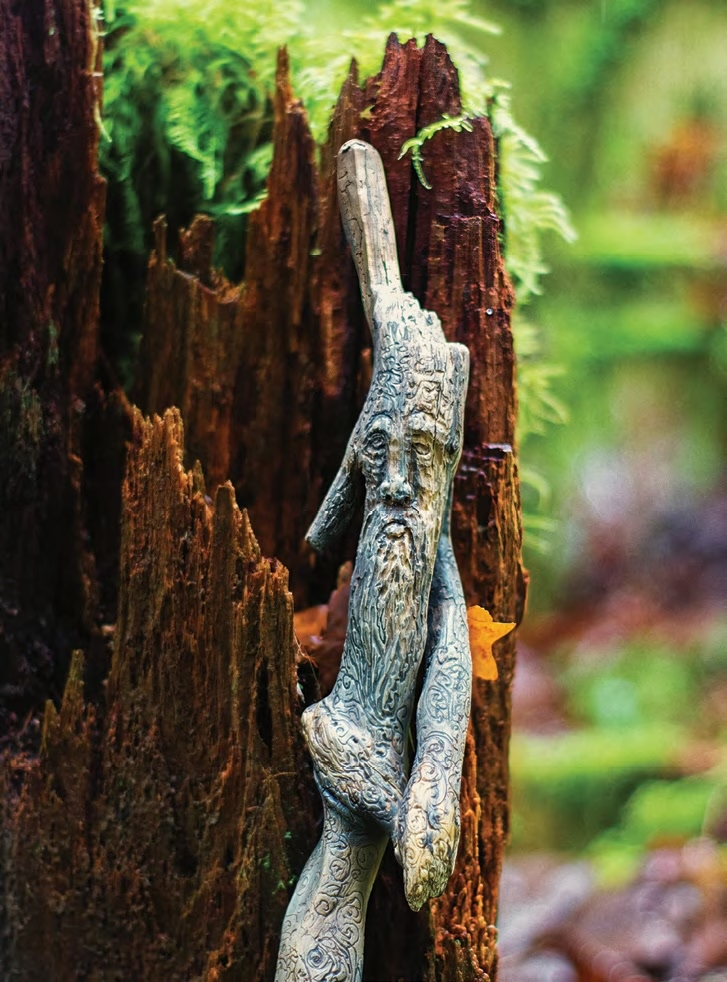
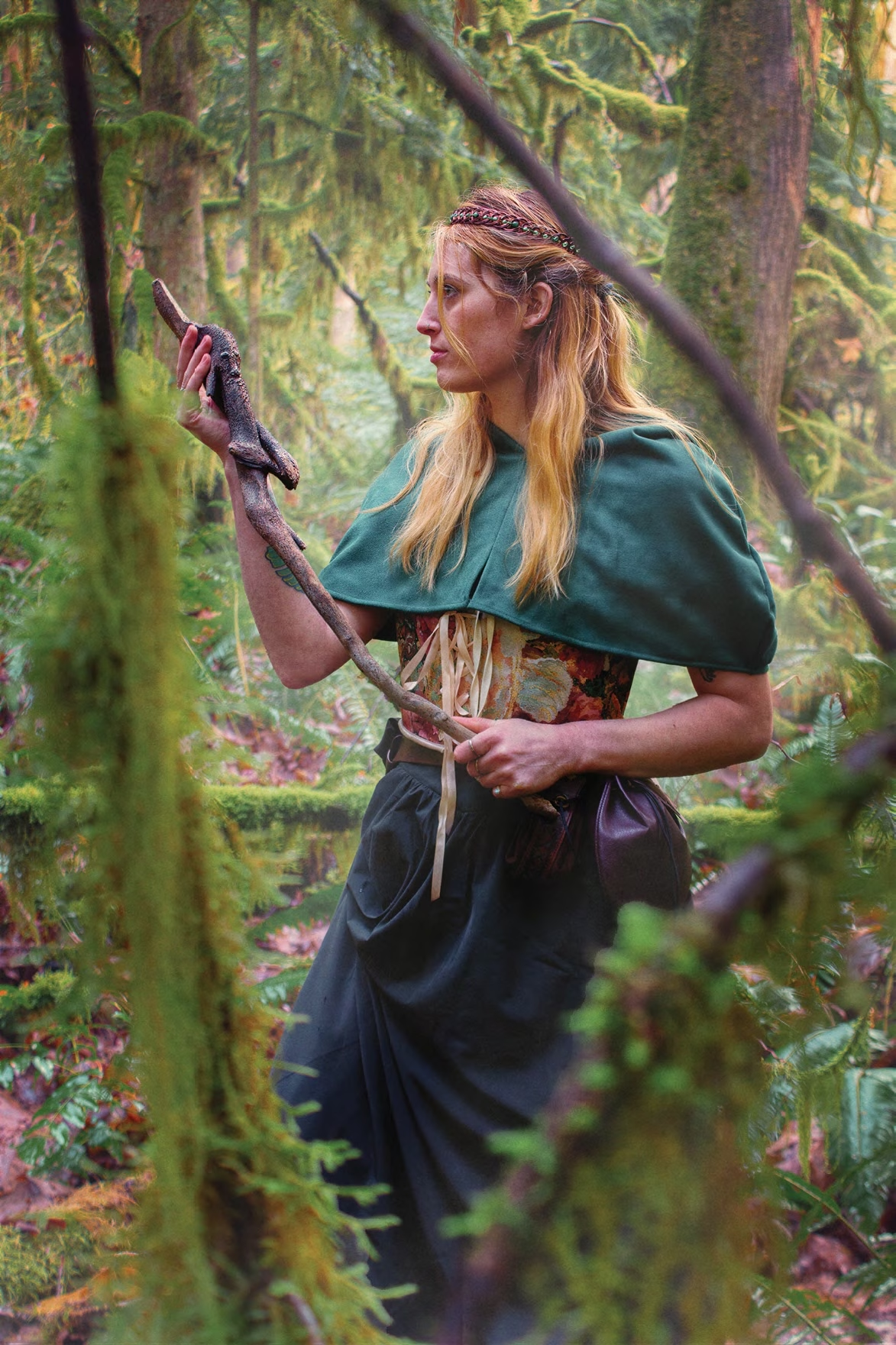
CARVING A LISTENING STICK
Humans and trees have always been in quiet exchange. What leaves the body becomes nourishment for leaf and needle. What the forest exhales becomes life within the chest. This is not metaphor. It is communion woven into biology. And yet, despite this intimacy, many have forgotten how to approach trees as kin rather than just scenery.
A listening stick is not created to conjure magic. It is created to remember connection.
It becomes an anchor, a tactile reminder that when stepping beneath branches and canopy, one is entering an ongoing conversation that
has never ceased. The forest does not begin speaking when attention turns toward it. It has always been speaking. The act of carving simply prepares the hands to notice.
You will need:
- One 12-to-18-inch branch
- Dremel tool with wood-carving bit of your choice
- Eye protection
- Face mask
- Fine-grit sandpaper
- Wood finish oil (such as tung oil)
Look for a fallen branch that feels balanced in the hand (roughly 12 to 18 inches long is ideal). It should not feel too heavy, nor too fragile. It should rest easily in the palm, as though it has already decided to belong there.
When you decide on a branch you may want to deepen the connection by placing a hand over the wood and ask, silently or aloud: “May I work with you?” The answer will arrive in sensation. If the branch feels neutral or welcoming, take it.
If it feels resistant, leave it where it rests.
Once you’ve picked your branch, clean it gently. If the wood is damp, allow it to dry completely before carving. Remove bark only if it flakes away easily.
When ready to carve, use a Dremel tool with a small engraving or carving bit. If new to using a Dremel tool, practice first on scrap wood. Familiarity builds confidence, and confidence allows presence. You can easily find tutorials online if needed. Remember to work in a well-ventilated area and always wear eye protection and a face mask to if you’re sensitive to wood dust.
Allow gentle pressure to guide the bit. Moving too quickly can splinter the grain. The wood responds to steadiness, not force. For beginners, try easy-to-carve symbols like a spiral to represent inward listening, rings around the branch to honor seasons and patience, or lines to represent roots that symbolize grounding energy.
For more experienced carvers, a face may be allowed to emerge from the grain.
Rather than forcing features onto the wood, study the natural curves, knots, and lines already present. Often the suggestion of a brow ridge or the hollow of a cheek is already there, waiting only to be revealed. Use a finer engraving bit and work slowly, carving shallow planes rather than deep cuts. Let the face remain partially formed as though it belongs as much to tree as to imagination.
As carving begins, notice the scent released from the wood. Notice how the vibration travels through the tool, into the branch, and back into the hands. The wood remembers being a tree. The body remembers being of the earth.
When finished, sand lightly with fine-grit sandpaper to soften rough edges. Oil the stick with a natural oil such as tung oil to deepen the grain and protect the surface.
To use your listening stick in meditative work, sit with your back against a tree. Place the carved end gently against the earth. Close your eyes and say something like, “I am listening.”
Nothing more is required, as this branch does not grant one power but restores awareness. It is a remembrance of breath shared between body and branch. And that exchange has been happening long befSore any carving began.