










Photography by Cristin Hinze-Heart
Inspiration
I can feel the moon calling to me through the walls of our tent, pitched on a little island on a family sailboat trip off the coast. I look over my sleeping family and very quietly unzip just enough of the door to slip out—not much was needed for my thin 12-year-old body. My breath catches in my throat as I witness for the first time the beauty of moonlight reflected on ocean water. I can feel it awaken and soothe something in me all at once, and I’m compelled to shed my clothes on the beach and wade into the frigid water to feel the dappled moonlight on my skin. I sing to the moon in utter reverence, completely unselfconsciously alone in the moonlight. That night, something awakened in me. Even as I navigated the tricky waters of growing from girl to woman, I kept returning to the moon and her plants for grounding and guidance.
Years later, I’m in a sauna full of herbal apprentices, filled with soothing mugwort steam. I’m the youngest there, by probably at least twenty years, and am listening to my older friends share feelings rarely spoken aloud outside this cocoon of safety. They say they feel invisible; that as their youth faded, so did their relevance.

THE MOONWISE MYTHOS
(for telling, for remembering)
In the indigo darkness of the Time Before Land, stars spilled like a milky elixir across the sky, their droplets condensing to form the moon we know so well.
In those early days, the moon hung ten times closer, and the sapphire tides surged a thousand times higher. It was a world of heaving waters and thunderous rhythms, where the ocean rose and fell like breath. And yet, it was this very motion—this slow exhale of the sea—that nudged the moon gently away. A cosmic sigh lengthened the distance between them, but love kept them tethered. The moon could not bear to leave her orbit.
She watched from above as the blue planet shimmered and shifted. Below, the oceans glowed with ancient breath—threads of cyan, known in old tongues as Silk of Dawn. These earliest beings spun sunlight into life. From them came every bloom, every wing, every question.
When land rose, the dragonflies followed. Giant and glinting, they stitched themselves across the sky like living constellations. The air was different then. The stars told different stories. The dusk blushed in lapis and smoke. Moonlit mist shimmered like blue opal.
The dragonflies listened.
They read in the sky the tale of the moon and listened to her stories of stars flowing like a river—dancing and changing, filling her soul with the ache of lost friends, their light still shining in ghostly silence. These wise, ancient dragonflies loved the moon for her stories. They worshipped her for her gentleness. They became the first to be Moonwise.
They danced not in temples but through reeds and rising vapor, their wings catching moonlight like silver nets. They whispered her stories to one another, hummed her hymns in the hush of twilight. And the moon, ancient and moved, wanted to thank them.
And so she did what the moon does best—she poured herself into form.
From stardust, ocean water, and moonlight she shaped eight mythic vessels: the Moon Pitchers. Inside each was not wine nor water but liquid memory—not facts or dates but sensation. The hush of wings in twilight. The warmth of another’s body beside you.
The quiet strength of survival. The ache of tenderness. The shimmer of awe.
When poured, they sing—the chime of the moon’s tears caressing the ocean’s form, a sound like silver bells echoing across pale cerulean waves.
She gifted the vessels to the dragonflies, her first priestesses.
“For you who listened,” she said. “Carry these stories. Drink from them when the world grows sharp. And pass them on to those who will remember.”
And so began the lineage of the Moonwise.
The jars were passed from one keeper to the next—not always by blood, but by resonance. From mother to daughter.
From elder to apprentice. From those who had carried much to those just beginning to hold. They passed through ammonites and mammals, through fur and feather, through matriarchal societies of every shape. The knowledge of the moon vessels was preserved not in books but in lullabies, in hand-touch, in the shared silence of those who know.
To be Moonwise was never about conquest. It was about care. It was not loud. It was luminous. It honored the lines on a woman’s face as a map of her becoming. It understood that wisdom pools in the hollows—like midnight pools beneath glacial moons.
But humans, in time, forgot.
Patriarchy took root. The world shifted its gaze from the moon to the mirror. The vessels were hidden. The stories were silenced. The priestesses aged and died, their wisdom carried only in the bones of mountains, in fragments of dreams, in glimmers that returned in moments of quiet knowing.
Or so we thought.
Because memory, even when buried, waits.
And the moon still watches.
When the ache for ancient wisdom rose again—when the world longed for softness, for rest, for the cool hush of blue—the vessels stirred.
They felt the call. A resonance, low and trembling. The aching of generations unsung.
And so they came. Not all at once, but slowly, softly—like a fog rolling in over a sapphire sea. Moonlight glancing off pottery shards in dreams, in clay speaking softly to nimble fingers, in the wild storm of a soda kiln firing, in intuition, in sudden knowing.
They found me. Not because I am Moonwise—not yet—but because I had begun to listen. Because my dreams had turned cobalt, my longing turned blue-gray with reverence. Because I, too, had searched for stillness beneath the surface of things.
This gathering, Moonwise, is a ritual of reawakening.
It honors the women who wear their lives in their smile lines, who carry the weight of their trials in silver strands of hair. It uplifts the beauty of aging, of ripening, of knowing. It sings in tones of smoke blue, lapis, and moonlit periwinkle.
To be truly Moonwise is to have lived to see many blue moons. To have dissolved and reformed. To have softened and kept shining.
I am not Moonwise—but I am old enough to recognize the glow in others. To honor what I have yet to become. I offer this gathering as a gesture of reverence. A weaving of memory. A way back to the forgotten path.
Let the vessels be filled again. Let the priestesses be awakened. Let us sit beneath the moon, in the hush of blue night, and remember who we were— who we still are.


THE MOON GODDESSES
Moonwise is a ceremonial portrait project and immersive art experience honoring the power, beauty, and visibility of aging. In a society that often renders older women invisible, this work invites us to reconsider what it means to become more radiant, more whole, and more deeply seen with time.
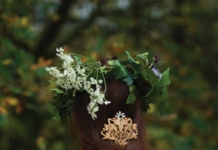
Six women—chosen for their wisdom, resilience, and personal transformation—gathered for a weekend-long retreat held beneath the full blue moon. Through shared ritual, reflection, and creative expression, each woman crafted a symbolic headdress, adorned herself in personal mythology, and stepped into the role of goddess—not metaphorically, but fully.
The resulting portraits show each participant holding a luminous handmade moon, a gesture that reclaims both the spotlight and the archetype of the elder feminine as a source of light.
Moonwise is a ceremonial lunar art and photography project exploring feminine wisdom, aging, ritual, and transformation through the symbolism of the moon. Created by Miss Wondersmith and photographed by Cristin Hinze-Heart, this immersive experience honors the beauty, resilience, and visibility of elder women as living embodiments of goddess energy. Blending mythology, storytelling, and sacred portraiture, Moonwise invites readers to reconnect with lunar cycles, ancestral memory, and the radiant power that deepens with time, reminding us that wisdom, like the moon itself, only grows more luminous through its phases.