
















Photographer: Ava Rymer @gingeredspice
Model: Molly Katherine @scarlett.o.hair
Gowns: Chotronette @chotronette
Florals: Mary Love with Love is in the Air @loveisintheairevents
Venue: Vaughan House Greenhouse & Enchanted Cottage @vaughanhouse
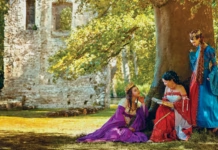
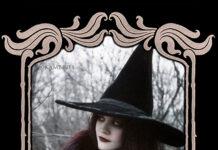
A rose is a broom is a wand is a door. A door is an hour is a way into a bright burst of dreams that are color and magic and a new season, a new life, for an autumn queen tangled up in enchantments. The dryads have watched over our queen pictured here,
Molly Katherine, for how long? A week? A summer? A century? Long enough for her talisman rose to have darkened and her hair to have grown into the branches. With the first chill in the air, the magic that clings to her stirs—Wake up, wake up!
Molly grips the stem of the rose. It is not the blossom that will return her fully to life; it is the thorns. So she dreams, ’til the stem transforms into the handle of a broom and the forest a familiar.
When she opens her eyes, her first thought is of home.
A stone dragon points the way. She and the broom take off … for a palace? No, no, no—what she needs now is a cottage.
An enchanted one. She has plans to lay.
Autumn is the season of memories and plans. This is the time for looking back on the year thus far and dreaming up future magic. You gather mushrooms and firewood, the last foraging from the glen. Scour the windows, plump the pillows, set a soup pot to simmering. Settle in with a book or a craft and mull over who you’ll be next.
There is no better place for a season’s contemplation—and reinvention—than a cottage. We become our best selves in a meaningful space, one with a connection to the earth and the past, a place for contemplation, safety, comfort, the glow of hearth and heart.
Naturally, we would follow Molly just about anywhere.
We are lucky that she headed for one of our mutually favorite haunts, the Vaughan House near Lynchburg, Virginia. Their new cottage—perfect for queens, fairies, witches, all manner of enchanted creature—is just the place to regroup.
In its traditional definition, a cottage is a small home without land. Other than that, it could be almost anything. It could cluster with others in a village; it might stand alone on a moor, in the middle of a forest, or the edge of a bog, maybe teeter at the top of a cliff or nestle into the rock just below.
Cottages are history, fairy tales, romance, tradition, abundance. The pluckiest heroines (and most wizened witches) live in cottages. They’ll take a palace, sure, once they’ve earned
it—but they start their lives the hardscrabble way and have to learn to value the so-called simpler things such as good bread and family love. Especially in a tale by Hans Christian Andersen or the Brothers Grimm, when a cottage might at first look to the characters like what we’d call a hut, even a hovel: something mean and poor, a starting place rather than an end.
I grew up with a version of “Hansel and Gretel” that begins in such a hovel, where the parents cannot manage to put food on the table. When Mother and Father decide, regretfully, to send the children into the forest to fend for themselves, the kids make an unpromising start by using the bread in their supper basket for marking their path. There’s a bit of good luck when they spot a cottage made out of glorious food—what says “Welcome home” better than a beautiful meal? Plentiful food, full bellies, pleasure … It all sounds great to the resident witch too, as long as the children feed her in return.
It is her cottage after all. Her home. And just look at how creative she’s been with building and decorating it. At the very least, the place continues to define ingenuity, as Hansel and Gretel use their wits to escape.
They return, of course, to the cottage where they were born, and their remorseful parents celebrate their arrival.
In a bustling world, we yearn for home, for simplicity free of the pressures that come with living crowded into cities, competing for space. We want a home with a personality, a sense of tradition verging on nostalgia (and what’s wrong with remembering the best of the past? Nothing). Cottages are quaint in the best way, one-of-a-kind and picture-worthy: the walls half- timbered, rock-faced, wood-shingled, or coated in pebbly harling and tinted white or ochre; the roof thatched or slate-shingled, peaked, sturdy. Naturally sourced, connected to the earth, they are part of our autumn dreams, when we all want to be witches.
And our art and our stories. In Dutch master Adriaen van Ostade’s Cottage Dooryard of 1643, a father gazes over laundry, a chicken coop, a boy playing with a dog, a mother cleaning mussels, a daughter tending a younger sibling. It’s a vision of life that is simply life, a quiet contentment. Berthe Morisot took us indoors with her Cottage Interior of 1886, in which the artist dares to show light colors, a table set for tea, and a girl framed in a doorway, moving from one space to another as she steps toward the transformation of young womanhood.


Now step into The Enchanted Cottage of 1945, an early romantasy movie in which two disfigured lovers see each other as they really are inside. We know all along that Dorothy McGuire and Robert Young are meant for each other—if only they weren’t so determined to see themselves as homely. What do looks matter anyway? Well, just in case: The cottage shapeshifts their exteriors to match the gorgeous people they are deep down, and then—even better—they accept the love that’s offered, and they become their true selves freed of concern about their appearance.
A dream cottage hovers behind every cascade of pink roses in a Pre-Raphaelite painting. John William Waterhouse’s Soul of the Rose (1908) is all sensory delight as a young woman revels in the pleasures of smell and touch; one hand cups the petals gently while the other digs into the rough wall as if to say that she’s ready for all experience.
Claude Monet’s 1925 House Among the Roses is a quintessential impressionist confection celebrated in suggestive strokes of color, not rigid forms and boundaries. It depicts the house where the artist lived in Giverny—rather, a portion of that house, for the whole home is quite grand. In painting just a portion of it, he created an intimacy and dizzy lyricism to hint that even those who can afford something fancy prefer a cottage.
Inside, a cottage is just right for serious work too. Agatha Christie’s Miss Marple lives in the last cottage on Old Pasture Lane. From the comforts of her tea table and easy chair, she puts chaos into order by solving all manner of nasty murders inside cozy novels.
Where does Rat live in The Wind in the Willows? Sure, it’s called an underground home, the Dulce Domum, a burrow—but look at the pictures Kenneth Grahame’s novel inspires. You’ll see books and fireplaces, a cupboard bed with a curtain to draw snug, a simple table where Rat can write poetry. Inside, it’s all cottage.
In our photo story, Queen Molly makes one transformation on her way into the cottage, another once she’s in it. Tugging at the door isn’t enough to gain entrance; you can’t just assume that the cottage is waiting for you. So she sleeps in the courtyard and wakes to embrace the season in its riot of ruddy color, its abundance of pumpkins and gourds, seed pods and stone. Only then does she find the home she didn’t know she was seeking.
You know you live in a cottage. Whatever it’s called, whatever it’s made of, it’s your safe space, your bastion and refuge, your locus amoenus of inspiration. Open the window; let the brisk air scour out the cobwebs (the ones no one is using, anyway). Fill it with the season’s flowers and pictures and books; hang herbs to dry from the rafters and do your housework barefoot. Or leave the walls blank and let the space speak for itself. If your home is an apartment, let it be a cottage of the mind; its physical shape means next to nothing when it follows the heart of its occupant. No matter how big or small, if there’s room for a stack of books, you have a library like the one where our Molly curls up to lose herself in other worlds and lives.
We consider autumn to be the kindest season. After summer wanderings, you return home to anchor yourself in your community. That pot of soup that Molly cooked up a few hours ago—surely there’s someone in the village who could use a bowl. The queen will bring it over herself with a heavy round loaf of bread, stepping carefully around the marshy places in the path.
Our Molly may flirt with spectacular gowns stitched together from fae wishes and laughter, but she ends dressed for practical tasks, perched in the kitchen with a mug of tea. Ballgowns and rubies are all very fine, she thinks, but kindness is an art too, and its own sort of luxury. She’s really just at the start of her fairy tale.
Let the autumn magic begin.
Subscribe!

Enchanted Living is a quarterly print magazine that celebrates all things enchanted.