










Feature Image:
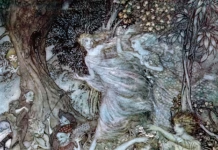
A Scene From ‘A Midsummer Night’s Dream’ (1873)Image courtesy Wikimedia Commons
When fairy fever struck the Victorians, they never recovered. Many would say thank goodness for that, as this fever created some of the most beautiful art to float gently on the breezes of the 19th century, art that still captures our imagination today. One of the most impactful yet mysteriously unknown proponents of this fashion for fae was a modest young artist from the southwest of England. This is the story of John Simmons (1823–1876).

“By the time Simmons found his forte in fairyland, it had already been in fashion for over a decade. On stage and canvas, Shakespeare was always a commercial favorite, and The Tempest and A Midsummer Night’s Dream fit the fashion for the supernatural. At the end of the previous century, fantasy artist Henry Fuseli (1741–1825) produced influential and popular illustrations for a folio of the Bard’s plays that enabled them to be reproduced and sold to a greater audience. His classical yet raucous images of Titania and Bottom paved the way for a genre of art that could be literary and still pleasingly nude. This foreshadowed what was to follow in the 19th century’s years of fairies, with artists such as Richard Dadd, who offered his interpretation of midsummer madness with Puck from 1841 and Contradiction: Oberon and Titania from 1854–58.
A Midsummer Night’s Dream also held sway on the stage, delighting audiences during this period. Its poetic language, lack of tragedy, and fantasy elements lifted audiences from the industrial modern world they inhabited. Samuel Phelps’s production at Sadler’s Wells in 1853 used layers of green and blue gauze to create a dreamlike separation from fairyland, close to us but still beyond our grasp. Opera singer and producer Lucia Elizabeth Vestris (1797–1856) drew her audience into fairyland in her 1840 revival of the play at Covent Garden, using flittering lights around the theater to suggest the fairies when Oberon proclaimed that they “through the house give glimmering light.” With her background not only in grand opera but also in burlesque, Vestris also knew how to tread the fine line between fairy costume and scantily clad scandal, which would become pertinent in the paintings that followed.
This experience with the fantasy of fairyland and the human yearning for it drew artists to create canvases that brought this specific Shakespeare play to an artistic audience. The plays beguiled the public, but more importantly, they ensnared the imagination of artists, drawing them deeper into this world. John Simmons had been a portrait and miniature artist, making a modest living in Bristol, in the crevice of Southwest England, across the water from Wales. Miles from the Royal Academy, he painted local dignitaries but did not create any ripples in the art world at large. These earnest and dignified works earned him membership in the Bristol Academy of Fine Arts, where he also taught. All in all, he was a well-respected man by both his pupils and peers and regarded as kindhearted, congenial, and an encouraging teacher. His marriage in the 1850s and the four children who arrived in quick succession in the 1860s seem to have coincided with his change from portraits to fairies, a reckless and inspired move that brought him fame, if only for a while.
His training as a miniaturist was surely a gift for a man entering the delicate world of the fae. Each of his visions was executed with clarity, detail, and a smooth finish as if it’d been brushed onto glass. His dreams of fairyland were both innocent yet alluring, free of any mischief and malice that crept into some fae imagery of the time. Instead, Simmons found his ideal of womanhood in the peerless Titania, statuesque and naked. In this he drew an interesting parallel to Vestris’s performances. Sharing the high art is all very well, but everyone would want to sneak a look at a beautiful naked lady. Take, for example, The Honey Bee Steals From the Bumble Bees (opposite), where we see a woman with pale moth wings regarding an errant bee caught taking pollen from a drowsy bumble bee. As the title references a line from A Midsummer Night’s Dream, we know it is the figure of Titania who is shining a light on this theft, the pinprick of bright burning from the tip of her hair-thin wand as she looks on admonishingly. Pale,with a cascade of platinum blonde hair, our Fairy Queen is naked but for the thinnest veil of gauze that seems to swoop from her waist to cover her modesty but very little else. It is debatable whether we are meant to feel titillated by this ivory queen or to await her judgement of our own misdeeds.

The same figure with powder-soft wings appears in one of Simmons’s best-known paintings, Titania (1866) (not shown here). On the frame is inscribed the repeated motto: “The honey bags steal from the humblebees.” The fairy queen once more glows in her spiderweb-thin gown, a spectral orb among the flowers and foliage. Echoing her pallor are the convolvulus or small field bindweed blooms, their meaning possibly hinting at the humility she’ll feel as she succumbs to the play’s spell and falls in love with Bottom. Her absorption with the natural world around her also speaks of her fascination with transience and mortality, which she, as an immortal being, can never possess.
Often in Victorian art of this genre, the fairy world seems within reach of our own, if we could only be aware of it. In Simmons’s 1870 Hermia and Lysander (opposite page), the mortal protagonists of A Midsummer Night’s Dream appear lost in a wood, unaware of the fae folk who surround them. In contrast to the flimsily clad fairies, Hermia’s robes are modest and her hair neatly bound. The couple is so absorbed with each other that Lysander doesn’t notice the fairy riding a mouse-powered chariot by his hand, nor the naked beauty atop the white hare with glowing eyes. Just beyond them, another stunning nude dances in the pollen of the honeysuckle while being fanned with a peacock feather. Any one of those extraordinary vignettes should be enough to catch even the most ardent of lovers’ eye, so either our couple is devoted beyond measure or extremely shortsighted.
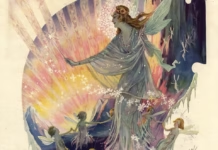
Another explanation for our ignorance of the magical world just beyond our fingertips is that we are quite literally unconscious of it. In his 1873 A Scene From ‘A Midsummer Night’s Dream’ (see pages 30-31), Simmons shows the sleeping figures of Hermia and Titania, watched by the fairies. Around them climb the bindweed flowers, but if the blooms are read as woodbines, they have a narcotic inference. Couple that with the foxgloves present in his other works, and there is a hint of drugging and dreams. As in John Austen Fitzgerald’s The Dream After the Masked Ball, also known as The Stuff Dreams Are Made Of (1864), or his 1858 painting The Nightmare, the Victorians were aware of the presence, welcome or otherwise, of fae folk as they slept. The overt drugging of the figures in A Midsummer Night’s Dream may well have chimed with the use, and misuse, of opiates in the 19th century and the hallucinations that could arise. It is easy to believe in the magical world that surrounds you if you must be deeply slumbering for it to manifest. Also, the presence of such light and fleeting beauty when life becomes dark and difficult brings a comfort of its own.

Simmons’s art was embraced by critics and public alike. He was praised in the newspapers for his poetical treatment and cited as a talented and rising star, but his glory was too brief to be of great financial benefit. He died suddenly, at only 51. Such was the shock and sorrow felt in Bristol that a subscription was raised within the artistic world to save his widow and four young children who were left penniless. Despite his brief career and modest number of small canvases, the paintings Simmons left were to join the canon of the fairy genre that brought pinpricks of light to the modern certainties of the 19th century.
Sometimes life seems beyond our control and without hope, but take comfort in the fact that just beyond your peripheral vision, a fairy is racing by in a mouse chariot … and be glad.
Subscribe!

Enchanted Living is a quarterly print magazine that celebrates all things enchanted.